Given a wavefunction, the observable quantity is the square of its magnitude.
Wavefunctions evolve in time, and so does the distribution of the particle. For energy eigenstates, the phase of the wavefunction evolves by a speed determined by the energy. In a general state, however, the probability distribution wiggles around as all the different energy eigenstates rotate in different velocities.
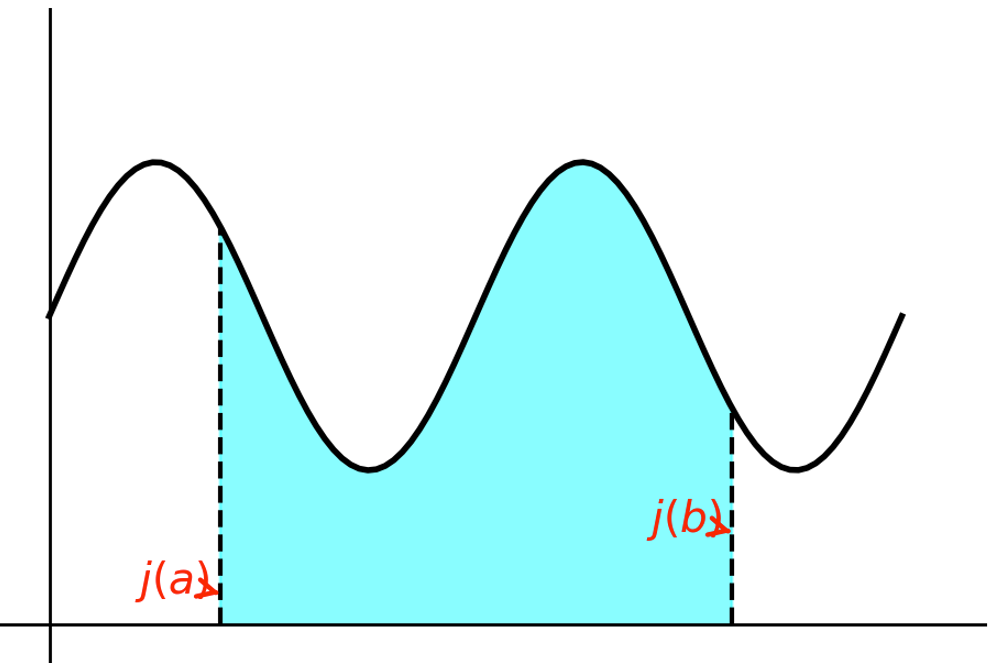
A natural question to ask is to compute the change of the probability in time. Fix a region \((a, b)\) and compute the probability that the particle lives in this region.
\[P(a < x < b) \ = \ \int_a^b dx \Psi^*(x, t) \Psi(x, t)\]
Take the time derivative of this probability. Differentiate under the integral and invoke the chain rule. The time derivative of each wavefunction can be written in terms of the Hamiltonian.
\[\frac{dP}{dt} \ = \ \int_a^bdx \left(-\frac 1 {i\hbar}\right) \left(-\frac{\hbar^2}{2m} \frac{\partial^2}{\partial x^2}\psi^*(x) + V^*(x) \psi^*(x)\right)\psi(x) + \int_a^b dx \left(\frac 1 {i\hbar}\right) \left(-\frac{\hbar^2}{2m} \frac{\partial^2}{\partial x^2}\psi(x) + V^*(x) \psi(x)\right)\psi^*(x) \]
The potential term cancels out and the remaining term can be simplified by taking out a \(\frac{\partial}{\partial x}\) from both of the integrals. Finally, we deduce the following.
\[\frac{dP}{dt} \ = \ \left[\text{Im}\left\{\frac {\hbar} m\psi^*(x) \frac{\partial}{\partial x} \psi(x)\right\}\right]_a^b\]
Define the term inside the bracket as \(j(x)\). The probability fluctuation is simplified as follows.
\[j(x) \ = \ \frac {\hbar} m\text{Im}\left\{\psi^*(x) \frac{\partial}{\partial x} \psi(x)\right\} \hspace{3mm} \text{then} \hspace{3mm}\frac{dP(a < x < b)} {dt} \ = \ j(a) – j(b)\]
The physical intuition behind \(j(x)\), the probability current, is as follows. The imaginary part of \(\langle \frac \partial {\partial x} \rangle\) can be considered as \(\hat p / \hbar\), momentum divided by reduced plank constant. Therefore, the probability current acts like velocity, momentum divided by mass.
Leave a Reply