The spectral theorem for finite-dimensional operators state that a normal matrix is unitarily diagonalizable into a diagonal matrix with complex eigenvalues and a self-adjoint matrix into that with purely real eigenvalues over the complex number field. This can be proved using Schur’s decomposition, which states that any matrix over the complex numbers can be unitarily decomposed into an upper-triangular matrix.
In this post, I present a particular result about real-symmetric matrices.
Theorem 1. For any real-symmetric matrix  , there exist an
  -by- matrix
  such that
![\[S^\intercal B S = \Lambda \]](https://danielson13579.com/wp-content/ql-cache/quicklatex.com-23db5766e6368f3d955024549ae2f629_l3.png "Rendered by QuickLaTeX.com")
where  is a diagonal matrix.
Before presentation of a proof, we need a technical lemma.
Lemma. Let  be an self-adjoint operator over a -dimensional Hilbert Space that is nonzero, i.e. there exist some vector
  such that
  . Then, there exist a set of unit vectors
  such that
  for all
  .
.
proof. Choose a basis such that  . Such a choice is guaranteed since is a nonzero operator. It is straightforward to show that given an upper-triangular matrix
  defined as
![\[T_{ij} \ =\ \delta_{ij} + \delta_{i1} \delta_{j1} - \delta_{i1} \frac{B_{j1}}{B_{11}}\]](https://danielson13579.com/wp-content/ql-cache/quicklatex.com-71f10dc5504cb2f0ba4ff8ab028c11cf_l3.png "Rendered by QuickLaTeX.com")
we have
![\[(T^\intercal B T)_{i1} = (T^\intercal B T)_{1i} = 0\]](https://danielson13579.com/wp-content/ql-cache/quicklatex.com-30e8ce7e21b8abcca7517c6fc2135799_l3.png "Rendered by QuickLaTeX.com")
for any  . Set vector
  the unit vector parallel to the first column and
  to be the remaining column vectors. By construction, we have that
![\[\bm v^\intercal B \bm e_{j} = 0\]](https://danielson13579.com/wp-content/ql-cache/quicklatex.com-2bba8e6288f16fbb64d1702a979f22ab_l3.png "Rendered by QuickLaTeX.com")
for any  . □
. □
This lemma basically tells us that given an operator on a finite-dimensional Hilbert space, it is possible to choose a vector and some subspace such that for the dot product  vanishes over the choice of the special vector and any other vector in the subspace.
Now, we are ready to present a proof of our theorem.
proof of Theorem 1. We show that there exist column vectors  such that
  for any
 ![i, j \in [n]](https://danielson13579.com/wp-content/ql-cache/quicklatex.com-d9e58347c3eb8dcb8391ee1f1800e875_l3.png "Rendered by QuickLaTeX.com") where
where  . For
. For  , the theorem is trivially true by choosing
  . Now, for
  , we apply the Lemma to obtain
  and
and  such that
  for all . By the inductive hypothesis, within the restriction of to
  , we obtain
  vectors
  such that
 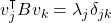 for some
  . Also, these new matrices
  are linear combination of
  ‘s, and therefore by linearity,
![\[\bm v_1 ^\intercal B \bm v_j = 0\]](https://danielson13579.com/wp-content/ql-cache/quicklatex.com-7735b5d2acd5c5e1678f7b0049d01cd7_l3.png "Rendered by QuickLaTeX.com")
for any . Choosing to be the collection of column vectors  , we obtain
![\[S^\intercal B S = \Lambda\]](https://danielson13579.com/wp-content/ql-cache/quicklatex.com-19cec98ffa5d2e3ae2e6bc3f8adcbe1a_l3.png "Rendered by QuickLaTeX.com")
where  a diagonal matrix. □
It appears that a clever choice of matrix  will allow to be orthogonal. However, Claude claims that such a choice for
  is known to not exist. Proof would require a different approach.
Leave a Reply