This post was inspired by a talk given by Professor David Damanik from Rice University. In this post, we will prove the Baire Category theorem for complete metric spaces and briefly talk about applications.
Notation. Let  be a metric space and
  . Then,
  denotes the open ball centered at
  with radius
  .
.
Definition. A space is Baire if and only if the countable intersection of dense open sets in is also dense.
For example, the space ![[0, 1]](https://danielson13579.com/wp-content/ql-cache/quicklatex.com-caffaae885a1287e3dfc31bfb1cd0694_l3.png "Rendered by QuickLaTeX.com") is Baire. Consider two dense open sets
is Baire. Consider two dense open sets 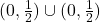 and
and 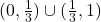 . The intersection of the two is
 ![[0, 1] \setminus \{0, \frac 1 3, \frac 1 2\}](https://danielson13579.com/wp-content/ql-cache/quicklatex.com-52e2289a95170ccce1dd8f410b9a90cd_l3.png "Rendered by QuickLaTeX.com") which is also dense in .
which is also dense in .
Theorem. Any complete metric space is a Baire Space.
proof. We prove by taking a sequence of balls that form an inclusive chain. Call the space and let  be a sequence of dense open sets. Recall that a subset is dense if and only if every nonempty open subset intersects with the subset. Therefore, take an arbitrary open set
  and show that it intersects with each
  at a common point for every
  . The two sets
  has a nonempty open intersection. Take a closed ball
  included in the intersect. Repeat the procedure with the open ball
  and
and  to obtain
  , and so on with
  and
and  to obtain
  .
.
Clearly, the sequence of closed balls form an inclusive chain.
![\[\overline B(v_1, r_1) \supseteq \overline B(v_2, r_2) \supseteq \cdots \supseteq \overline B(v_k, r_k) \subseteq \cdots \]](https://danielson13579.com/wp-content/ql-cache/quicklatex.com-75948ab5bdfdb4963d4cf2e5bb903233_l3.png "Rendered by QuickLaTeX.com")
The space is complete, so  for some
  as
as  goes to infinity. By construction,
  is common to all of the closed balls, therefore to all the sets and the initial open set
  . □
. □
Lets reformulate the result. A  set denotes a countable intersection of open sets. The Baire category theorem says that if the component sets of the open sets are dense, then the resulting set is also dense.
The Baire category theorem can be used to study decomposition of operators. A Schrodinger operator decomposes the space into eigenstates that correspond to pure point, singular continuous, absolutely continuous spectra. The Wonderland theorem (by Barry Simon) proves that the eigenstates corresponding to pure point and absolute continuous spectra form a dense subset in the space of all states. The proof involves the Baire category theorem.
References and further reading:
Leave a Reply