The goal of this post is to convince (not prove) that the delta function can be written as an integral of a complex exponential and it satisfies the sifting property. For a formal proof, please refer to a math textbook.
The main claim is that
![\[\delta(x - x') \ = \ \frac 1 {2\pi }\int_{-\infty}^\infty e^{ik(x - x')} dk \]](https://danielson13579.com/wp-content/ql-cache/quicklatex.com-d014ccaa1374952e0e5b854206eeed25_l3.png "Rendered by QuickLaTeX.com")
defines a delta function, and that the sifting property works for this definition, i.e.
![\[\int_{-\infty}^\infty f(x)\delta(x - x') dx \ = \ f(x'). \]](https://danielson13579.com/wp-content/ql-cache/quicklatex.com-d970477b5152f56a98ef55e2253e8725_l3.png "Rendered by QuickLaTeX.com")
Our approach is to define an auxillary integral
![\[\delta_{\alpha}(x) \ = \ \frac 1 {2\pi }\int_{-\infty}^\infty e^{-\alpha^2 + ik(x - x')} dk\]](https://danielson13579.com/wp-content/ql-cache/quicklatex.com-5ba2f713fbe223f821b14b72ca9fe988_l3.png "Rendered by QuickLaTeX.com")
and send  for positive values of
  . Completing the squares on the exponent and applying u-subsitution, the limiting integral can be expressed as a Gamma function.
![\[\delta_{\alpha}(x) \ = \ \frac 1 {2 \pi} \frac {e^{-(x - x')^2/(4\alpha^2)}} { \alpha} } \int _0^\infty u^{-1/2} e^{-u} du \ = \ \frac 1 {2 \pi} \frac {e^{-(x - x')^2/(4\alpha^2)}} { \alpha} } \Gamma(1/2) \]](https://danielson13579.com/wp-content/ql-cache/quicklatex.com-09ec3025276d722368fbdc51bcf33457_l3.png "Rendered by QuickLaTeX.com")
Thus,
![\[\delta_{\alpha}(x - x')\ = \ \frac 1 {2 \sqrt{\pi}} \frac {e^{-(x - x')^2/(4\alpha^2)}} { \alpha} }\]](https://danielson13579.com/wp-content/ql-cache/quicklatex.com-57ec8520536c3dcb9b289e4c4ed5a0e1_l3.png "Rendered by QuickLaTeX.com")
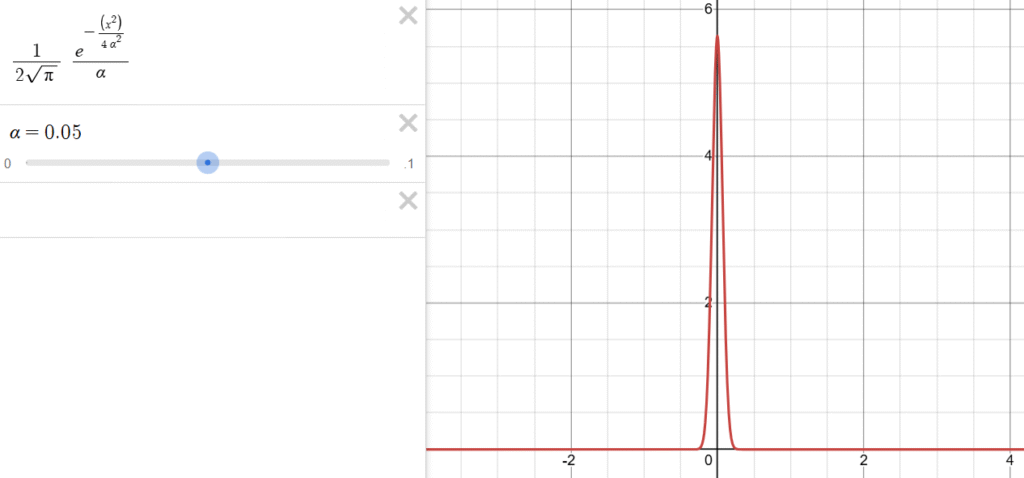
Figure: Desmos plot of a candidate limit  at
at  .
.
Move on to prove the sifting property. For convenience, choose  and that the candidate function
  is continuous. Outside
  , the function converges uniformly to zero. Therefore,
![\[\int_{-\infty}^\infty f(x) \delta_\alpha (x) dx \ \rightarrow \ \int_{-\epsilon}^{\epsilon} f(x) \delta_\alpha(x) dx\]](https://danielson13579.com/wp-content/ql-cache/quicklatex.com-9bb76117e36d2ceafb56c3bfda7e68a8_l3.png "Rendered by QuickLaTeX.com")
as goes to  , where
  is a fixed constant. Rewrite the second integral as
![\[\int_{-\infty}^\infty f(x) \mathbb I _{(-\epsilon, \epsilon)} \delta_\alpha(x) dx\]](https://danielson13579.com/wp-content/ql-cache/quicklatex.com-07f82cc09d9c77bb458e3302120e9ce4_l3.png "Rendered by QuickLaTeX.com")
and invoke Holder’s inequality for  . Each is normalized and integrates exactly to 1 over the real line.
(1) 
On the last step, the product of the indicator and was approximated to  assuming continuity. To show equality, prove the inequality in the other direction. Underestimate by a picewise linear function that is supported in the region where reaches a value greater than
  of its maximum height.
Since is concave,  by construction. We notice
![\[\int_{-\infty}^\infty f(x) u_\alpha(x) dx \ = \ \frac 1 {\sqrt \pi} \frac{1 + e} e f(0) \ \approx \ f(0). \]](https://danielson13579.com/wp-content/ql-cache/quicklatex.com-0b58903df00317c80890b349f9d5eaf1_l3.png "Rendered by QuickLaTeX.com")
It is convincing that a better choice of a test function  will give the lower bound
  . Combining the results, we claim
![\[f(0) \ = \ \int_{-\infty}^\infty f(x) \delta_\alpha (x) dx. \]](https://danielson13579.com/wp-content/ql-cache/quicklatex.com-88ac3bf88a2a9d8b41f7adc6f97a40d4_l3.png "Rendered by QuickLaTeX.com")
Leave a Reply